Beyond the Cheer: A Parent's Guide to Understanding Umpire Signals and Rule Nuances.

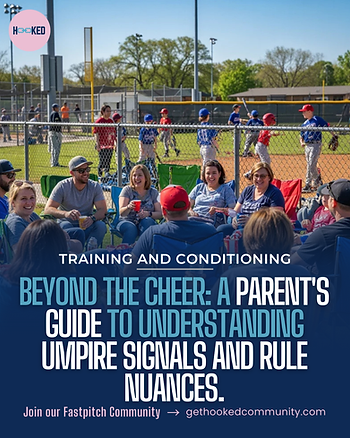
From the bleachers, it can sometimes feel like a secret language. A flurry of sharp gestures from the folks in blue, followed by groans or cheers from the crowd, often leaving you to wonder, "Wait, what just happened?"
For parents, the desire to support your athlete is immense. But that support transforms when you move from just being a vocal fan to being a knowledgeable one. Understanding the signals and the why behind the calls doesn’t just prevent you from yelling at a correct ruling—it deepens your appreciation for the game and allows you to truly see the strategic battle unfolding on the field.
So, let’s pull back the curtain. Here’s your parent’s guide to speaking the language of the umpire.
Part 1: The Universal Signals (What They All Mean)
These are the non-negotiables. Knowing these will make you feel instantly more plugged-in.
Safe: Arms swept down and to the sides, palms down. It’s a definitive "nope, not out!" signal.
Out: A sharp, fist-clenched punch into the air. The most definitive call in the game.
Fair Ball: A pointed finger directly toward the field of play.
Foul Ball: Both arms raised straight up above the head, palms forward. The universal "do-over" signal.
Time Out / Dead Ball: Both hands held above the head, palms facing each other. The umpire is stopping the clock and the action.
Play Ball: A simple point towards the pitcher with one hand. The show is back on.
Strike: For a swinging strike, the plate umpire will often give a vocal "Yeah!" or "Huh!" but no signal is required. For a called strike (a batter looking at a pitch), you’ll see a more pronounced signal: a right fist clenched at the side or a hammer motion with the arm, often accompanied by a vocal "Strike!"
Ball: No signal is given for a ball. Silence is the signal.
Part 2: Beyond the Basics: The Nuances That Cause Confusion
This is where the real game happens. These are the calls that often generate the most… passionate… discussions in the stands.
1. The Infield Fly Rule
The Situation: Runners on first and second (or bases loaded) with fewer than two outs. A batter hits a catchable fly ball in the infield.
The Call: The umpire will loudly yell, "INFIELD FLY, IF FAIR!" and give a signal (pointing up with one arm). The batter is automatically out, regardless of whether the ball is caught.
The Why (The Nuance): This rule exists to prevent trickery. Without it, the infielder could intentionally drop the ball and turn an easy double play, as the runners would have to stay near their bases. This rule protects the runners. The key for parents: the ball does NOT have to be caught for the batter to be out.
2. Obstruction vs. Interference
This is the biggest source of confusion. Remember this simple distinction:
Obstruction (OBS): This is a defensive mistake. It occurs when a fielder without the ball impedes the progress of a runner. The fielder is blocking the basepath or the base itself.
The Signal: The umpire will point at the infraction and yell "Obstruction!" and may use a hands-up, "safe" style signal.
The Result: The umpire will award the runner(s) the base(s) they would have likely reached had the obstruction not occurred.
Interference (INT): This is an offensive mistake. It occurs when a batter or runner impedes a fielder who is trying to make a play on the ball.
The Signal: The umpire will call "Time" and give a "time out" signal, then will typically call the runner out.
Example: A runner sliding into second base kicks the ball out of the shortstop's glove. That's interference.
3. The Look-Back Rule
The Situation: A runner is on base and the pitcher has the ball in the circle.
The Rule: The runner must immediately decide: return to the base or advance to the next one. They cannot just dance off the base or fake a lead. They must commit to one action.
The Call: If the runner is off the base and "frozen," the pitcher need only look at them and then step back onto the pitching rubber. The umpire will then call the runner out for hesitation.
Why Parents Get Confused: It looks like the pitcher isn't doing anything! But the rule puts the onus on the runner to make a decision once the pitcher is in the circle with the ball.
4. The "Neighborhood Play" at Second Base
The Nuance: On a force play at second base (trying to turn a double play), the fielder does not have to actually touch the base. They need to be "in the neighborhood" of the base while receiving the throw and then throwing to first. This is a safety rule to protect the middle infielder from a sliding runner.
What to Look For: The umpire is watching the footwork. If the fielder catches the ball and is clearly around the base, they will get the out call, even if their foot is an inch above the bag. This is a legal and accepted part of the game.
Part 3: How to Be a Knowledgeable Fan (The Best Kind of Fan)
Observe, Don’t Assume. Before you yell, take a breath. The umpire has a different, and often better, angle than you do in the stands.
Trust the Process. These men and women are trained and often love the game as much as you do. They are not the "opposition."
Teach Your Athlete. Explain these rules at home. A player who understands why a rule exists plays smarter and avoids costly mistakes.
Applaud the Good Call. It’s a hard job. A simple, "Good call, blue!" from the stands can go a long way.
Understanding the signals and the spirit of the rules turns the game from a blur of action into a chess match. You’ll start to anticipate plays, understand strategic decisions, and celebrate not just the home runs, but the brilliantly executed force-out or the savvy base running.
So the next time the umpire makes a signal you know, share that knowledge with the parent next to you. You’re not just watching a game anymore. You’re reading it.
Have a rule you’ve always wondered about? Drop your question in the comments


Comments